

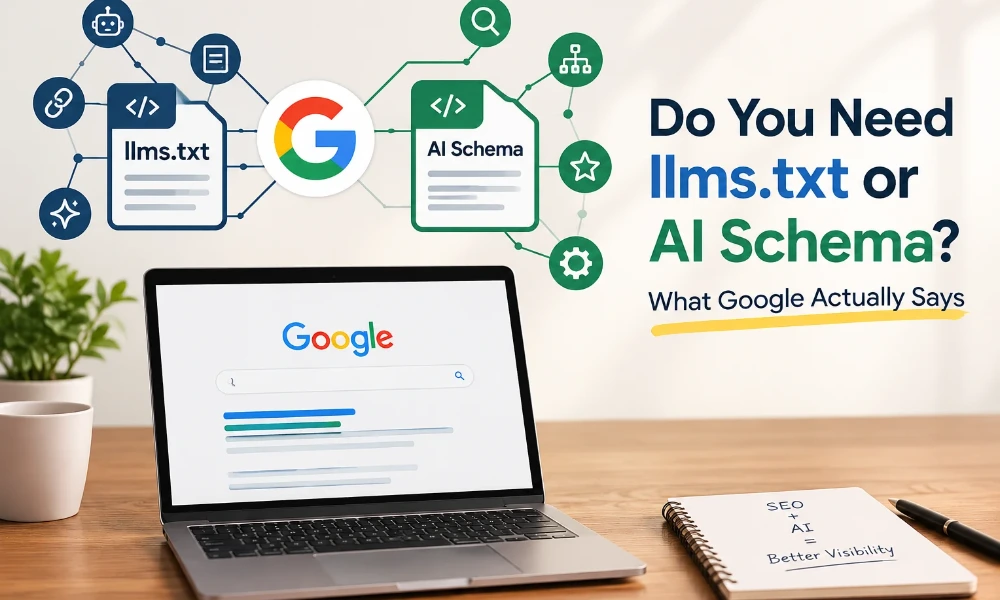
Every few months, the SEO world gets a new must-do trend. This year, it’s llms.txt and “AI schema.” You’ve probably seen people on LinkedIn saying that without them, your website will disappear from AI search. If you’ve been wondering whether you’re missing something in your SEO, this blog is for you.
Let’s set the hype aside and look at what Google actually says.
First, what are these things?
llms.txt is a plain text file that you add to the root folder of your website, written in Markdown. The idea is to give AI tools a simple map of your most important pages, so they can find what matters without digging through messy HTML. In theory, it helps them understand your key content much faster.
“AI schema” isn’t an official term. People use it to describe adding schema.org structured data to a website, hoping AI tools will understand the content better and cite it in AI search results.
Both of them sound useful, and that’s exactly why so many website owners have started adding them.
What Google says about llms.txt
Google Search doesn’t require llms.txt.
According to Google’s May 2026 Search Central guide, llms.txt does not improve Google rankings, AI Overviews, or AI Mode visibility. Google also says there’s no need to split content into smaller chunks or rewrite pages just for AI search. Focus on creating helpful, high-quality content instead.
Having an llms.txt file won’t get your website penalised, but it won’t guarantee better visibility in Google Search either. If you already have one, there’s no need to delete it. Just don’t expect it to improve your Google rankings.
One thing that might cause confusion is that Chrome’s Lighthouse tool has started checking for llms.txt in its agentic browsing audits. However, this has nothing to do with Google Search rankings. It’s a separate feature designed for a different purpose.
So, just because llms.txt passes the Lighthouse check, it doesn’t mean it will improve your Google rankings.
What Google says about “AI schema”
The same goes for schema, with one important difference. According to Google’s guidance, structured data isn’t compulsory to appear in generative AI search, and you don’t need to add any special schema.org markup just for AI search.
In other words, don’t think there’s a secret “AI schema” that unlocks AI search. But that doesn’t mean schema is useless. Structured data still helps Google understand your page content, and it can make you eligible for rich results like review stars, product details, and breadcrumbs.
Simply put, structured data is useful for rich results, but it’s not a shortcut to guaranteed AI citations.
So keep using schema types that match your page content. Article, Product, Organization, and Breadcrumb are all good choices where they fit. But don’t mark up content that users can’t see on the page, and don’t assume that adding schema alone will get you into AI Overviews.
Why AI Overviews don’t need special files
This is an important point that many people overlook.
Google’s AI features use content from its existing Search index. If Googlebot can crawl and index your pages, and your content is genuinely helpful, your website already has a chance to appear in AI search results.
You don’t need to do anything special to get into AI search.
That’s why Google’s advice stays so simple:
- Create content that is genuinely helpful to users.
- Make sure your website can be crawled and indexed.
- Keep your pages accessible and easy to understand.
It might sound boring, but in SEO, long-term results often come from getting basics like these right.
What about ChatGPT, Claude, Perplexity and others?
Google isn’t the only player in AI search. Tools like ChatGPT, Claude, and Perplexity also find and cite online content.
So, does llms.txt help these tools? The honest answer is that there’s no clear evidence yet. Major AI providers, including OpenAI, Anthropic, and Perplexity, haven’t confirmed that they use llms.txt to decide which content to cite.
It’s best to treat llms.txt as an optional experiment rather than a priority. If you can create it in 20 minutes, give it a try. But don’t spend a whole week on it or present it to clients as a major growth strategy.
So what should you actually do?
Here’s the simple checklist I’d give any client when sharing SEO recommendations.
1. Write for users first.
Answer the real questions people ask, and keep your answers clear. Include your own experience and original insights in the content. Original information is far more valuable than simply rewriting what others have already published.
2. Make sure your pages can be crawled and indexed.
Check your robots.txt file, fix any broken links, and keep your website fast. Search engines need to be able to reach your important pages.
3. Use schema on the right pages.
Schema types like Article, Product, Organization, and Breadcrumb can be added where they match your content. Just make sure the structured data is consistent with the information visible on the page.
4. Keep your content accurate and up to date.
Outdated information weakens user trust. Regular updates help you keep offering content that is useful to both readers and AI tools.
5. Treat llms.txt as optional.
There’s no harm in creating one, but it shouldn’t be a priority. Consider it only after you’ve finished the important SEO tasks.
6. Don’t restructure your website just for AI.
Breaking your content into strange little chunks, or writing in a robotic style for AI, can make the experience worse for readers. Keep your content clear and natural.
Conclusion
If you remember just one thing from this blog, let it be this: there is no shortcut to AI visibility that skips good SEO.
Google’s guidance is very clear. The same SEO practices that work in regular Google Search are also relevant for Google’s AI features.
You don’t need llms.txt to appear in AI Overviews, and you don’t need special AI schema either. What you need is content that’s worth citing, and a website that search engines can easily discover.
The next time someone says a new file will “unlock” AI search, ask them one simple question: “Where did Google actually say that?” This applies to any agency you hire, including an SEO company in Thrissur. A good partner will point you to real evidence instead of selling you the latest trend.
If there’s no clear evidence, don’t waste your time on it. Focus on the SEO work that actually improves your results.