
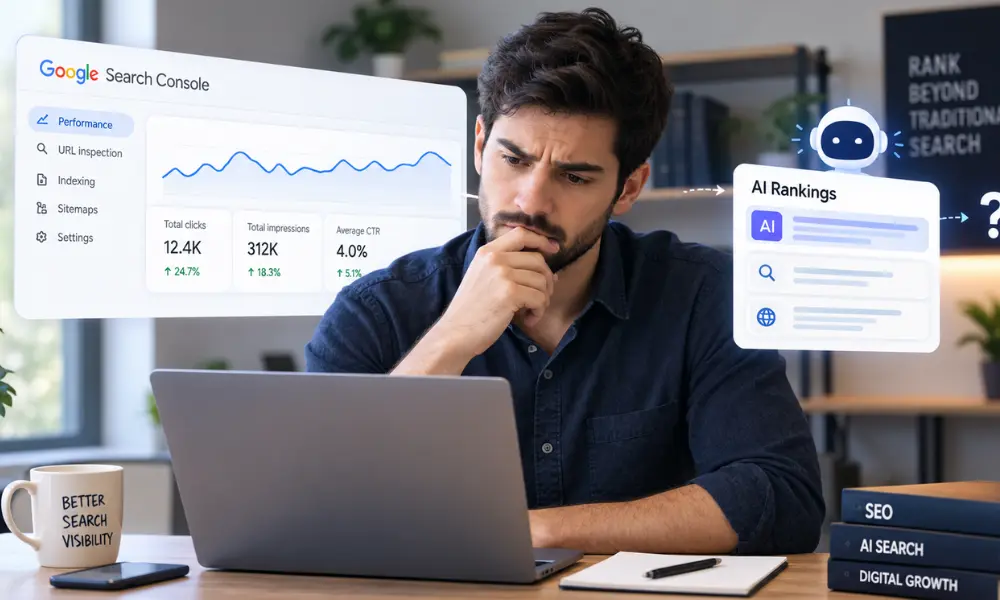
If you have recently checked Google Search Console to understand how your website is actually performing in AI search results, there’s an uncomfortable truth you’re looking in the wrong place.
GSC was built to measure website performance in traditional blue link search results. But the search world is slowly changing, and many marketers still haven’t fully realized the impact of these changes.
Let’s take a look at what’s actually happening behind the scenes.
GSC Was Built for a Different Era of Search
Google Search Console does one thing very well it shows you how your website performs in traditional Google search results.
You can easily track things like clicks, impressions, average position, and CTR in GSC. Since it was designed for the traditional search world, it is still very useful for measuring that kind of performance.
But search itself is changing.
When a user asks a question in Google AI Overview, or uses AI tools like ChatGPT, Perplexity, or Claude to find an answer, that interaction may not be visible in GSC in the same way.
Your website content might be used as a source to generate an AI answer. But you may not get direct visibility into that in GSC.
There may be no impression count, no position tracking, and sometimes not even a click, because the user gets the information from the AI answer without visiting your website.
That’s the main problem.
GSC mainly measures visits and traditional search performance. But in AI search, being visible without getting a website visit is becoming increasingly important.
Why Doesn’t Position Tracking Work the Same Way Anymore?
Traditional SEO rankings are very simple.There is a list of search results, and you can track whether your website is in position 3, 5, or 11.
But AI generated answers do not work that way.
There is no fixed ranking list here. AI collects information from multiple sources and creates an answer based on that information.
If the wording of a query changes, the answer can also change. Results may vary based on the user’s context. Even if someone asks the same question twice, the AI may cite different sources each time.
So, if an AI tool cites your content, paraphrases it, or uses it as a data point in a longer answer, Google Search Console does not have a separate column to show this.
Your website may be appearing regularly in AI-generated answers. But when you check your Search Console dashboard, there may not be any clear indication of it.
This is the confusion many businesses are facing today.
Traffic patterns are changing. For some queries, your traffic may seem to be decreasing. But Google Search Console does not have complete data to clearly explain why this is happening.
What Is Actually Happening Behind the Scenes?
Some important things are happening now that Google Search Console was not designed to track.
Zero-Click AI Answers
Users are getting the information they need directly in the AI answer.
They may not need to visit the website at all.
So, there is no click, no website session, and no traditional data point in GSC even if your content was used as a source.
Citation Without Traffic
Some AI tools link to their sources.
But that referral traffic may not always be tracked in analytics like traditional search traffic. It is also not easy to measure it as a traditional “ranking position.”
Model Specific Visibility
Your website may appear differently in Google AI Overviews, ChatGPT, and Perplexity.
Each platform uses different systems, indexes, training data, and retrieval methods.
So, there is still no single dashboard that combines all this data in one place.
Fluctuating AI Results
The same question can sometimes give you different answers when you ask an AI twice.
Different websites may appear as sources, and the citations may also be different.
This makes it difficult to compare AI search with the traditional “Position 1 to Position 10” ranking model.
So, What Should You Actually Do?
This does not mean GSC is useless.
GSC is still an essential tool for understanding your website’s performance in traditional Google Search.
But if AI visibility is important for your business, you need to expand your measurement approach beyond traditional SEO metrics.
Things You Can Do:
- Manually test the important queries you are targeting on platforms like ChatGPT, Google AI Overviews, and Perplexity.
- Track your brand mentions and AI citations.
- Make your content simple, clear, structured, and easy to understand. Create content that AI systems can easily extract and summarize.
- Keep an eye on new tools that can help you track AI visibility.
- Do not ignore traditional SEO fundamentals such as structured data, clear authorship, and topical authority.
- Focus not only on traditional SEO rankings but also on AI visibility and brand presence.
Honestly, there is still no perfect single-dashboard solution for measuring AI search visibility.
If someone claims they have a complete solution for this, they may be overpromising.
Instead, you can combine manual testing, referral traffic patterns, brand mentions, and AI citations to get a reasonably clear picture of your visibility.
It may not be as neat as a GSC report, but for understanding the current AI-driven search environment, this is a practical approach.
Final Thoughts
Google Search Console is not going anywhere. It is still important for understanding traditional search performance.
But in 2026, relying only on GSC to understand your full search visibility can be a mistake because search behaviour is changing.
AI search does not work like traditional search. So, measuring visibility on AI platforms also requires a different approach.
If it is difficult to understand where your website stands in this new AI driven search landscape, you can consider getting help from professionals who closely track these changes.
A good SEO agency in Thrissur can help you look beyond traditional SEO metrics, test your visibility across different AI platforms, and build a content strategy that targets both classic Google rankings and AI generated answers.
This way, when the search landscape changes, you do not have to rely on guesswork. You can adapt your strategy based on data.